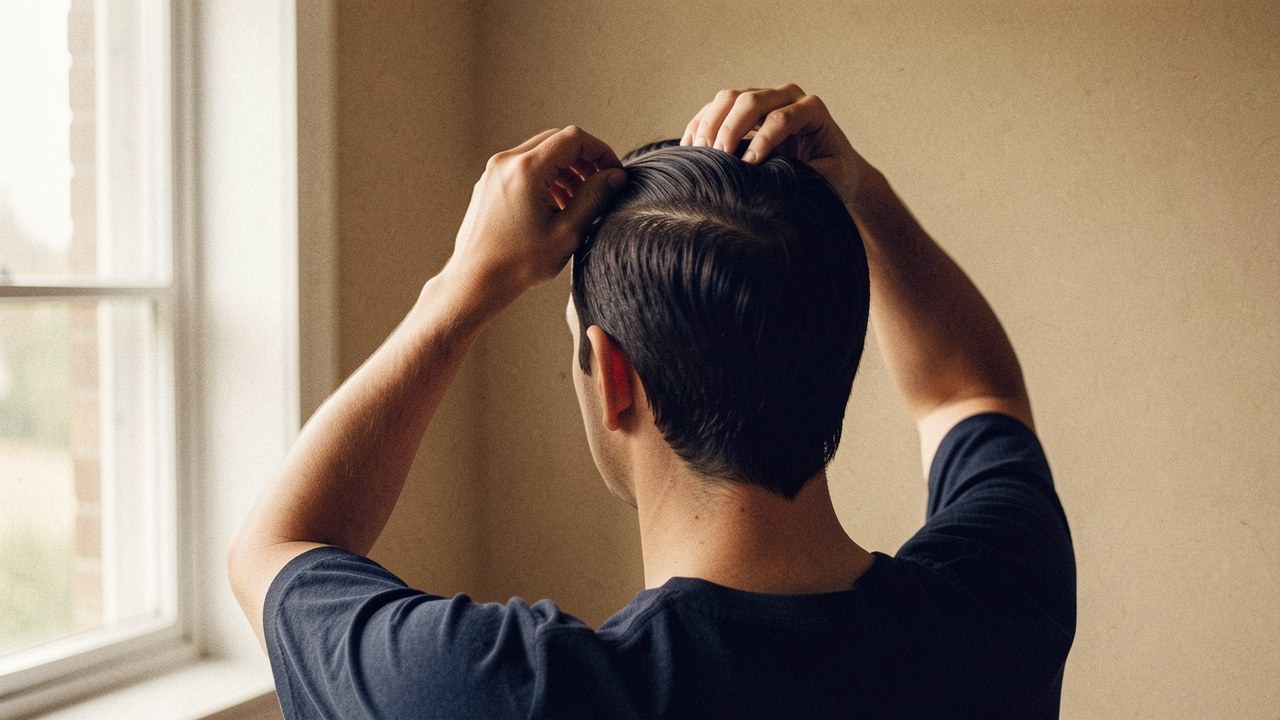
What alopecia means as an umbrella term
Alopecia is the medical term for hair loss — the absence or loss of hair in an area where hair is normally expected to be present. It is a category, not one disease. Under that single word sit many separate conditions with different causes, different scalp patterns, and very different outlooks for regrowth.
Because the term is so broad, hearing a diagnosis of alopecia tells you relatively little on its own. Two people with the same word on a chart may have nothing else in common: one may have patchy scalp spots that regrow, another may have a slowly receding hairline, and another may have a form of hair loss that leaves permanent scarring. The useful question is always which type of alopecia is present.
Alopecia can be localized to one area or diffuse across the scalp, and it can affect both sexes and all age groups, including children. That breadth is why clinicians begin by sorting hair loss into categories before discussing what to do about it.
- Alopecia means hair loss in an area where hair is expected — it is an umbrella term, not a diagnosis in itself.
- Hair loss under this umbrella can be localized or diffuse, and temporary or permanent.
- It can affect both sexes and all age groups, including children.
Sources: National Center for Biotechnology Information / U.S. National Library of Medicine, University of Rochester Medicine (U.S. academic health system), American Hair Loss Association
Common hair-loss patterns at a glance
Most everyday hair-loss questions come down to a handful of patterns. The table below compares them on three points that matter for orientation: where the loss typically appears, whether the follicles are scarred, and whether regrowth is possible. Attributions follow the categories used in clinical dermatology references and U.S. academic medical center patient education material.
- Androgenetic alopecia is the most common type overall and usually develops slowly.
- Alopecia areata is immune-mediated and often starts suddenly with smooth patches.
- Telogen effluvium is diffuse shedding that usually follows a stressful trigger by about three months.
- Traction alopecia is tied to hairstyling tension and is often reversible if the tension stops.
- Scarring alopecias are the group where hair loss can be permanent.
| Pattern | Typical distribution | Scarring type | Reversibility |
|---|---|---|---|
| Androgenetic alopecia (male- and female-pattern hair loss) | Men: vertex, bitemporal, and midfrontal scalp. Women: central scalp with minimal frontal hairline involvement. | Nonscarring | Potentially reversible; usually slowly progressive |
| Alopecia areata | Acute-onset patchy scalp hair loss; rarely total scalp loss (totalis) or whole-body loss (universalis) | Nonscarring, immune-mediated | Potentially reversible; may be a single episode or remit and recur |
| Telogen effluvium | Diffuse shedding across the entire scalp | Nonscarring, noninflammatory | Usually self-limiting; onset about 3 months after a trigger, duration about 6 months |
| Traction alopecia | Hairline thinning from repeated tension, such as tight braids, buns, ponytails, cornrows, extensions or weaves; also constant rubbing from head coverings | Nonscarring in early stages; can become scarring with prolonged pulling | Reversible once the tension is removed; may become permanent if pulling continues |
| Scarring (cicatricial) alopecia | Variable; includes frontal fibrosing alopecia along the frontal hairline, lichen planopilaris with irregular patches, and central centrifugal cicatricial alopecia starting at the crown and spreading outward, which is the most common hair loss type in Black people assigned female at birth | Scarring (cicatricial) | Permanent; hair cannot regrow where scarring has occurred |
Sources: National Center for Biotechnology Information / U.S. National Library of Medicine, Cold Spring Harbor Perspectives in Medicine (PMC / NLM), JAMA Dermatology (PMC / NLM), Penn Medicine (U.S. academic health system), Merck & Co., Inc. (Merck Manuals), Aurora Health Care (U.S. health system)
Temporary versus potentially permanent hair loss
The single most important distinction in hair-loss medicine is whether the hair follicle is preserved or destroyed. Nonscarring alopecia is the more prevalent category; in these conditions the follicles remain intact, so hair loss is potentially reversible and regrowth is possible. Scarring, or cicatricial, alopecia is different: the follicles are irreversibly destroyed, and hair cannot grow back in the affected areas.
That framework explains why some people regrow hair after an illness, a pregnancy, or a stressful period, while others see a hairline change that does not come back on its own. It also explains why traction alopecia is often grouped as reversible: early on, the follicle is still there. When pulling continues long enough, the same area can shift into permanent damage.
Two practical implications follow. First, the temporary-or-permanent question is usually answered by the type of alopecia and the state of the scalp, not by how much hair has been lost. Second, because scarring alopecias are permanent once scarring occurs, they are the group where prompt professional evaluation matters most.
- Nonscarring alopecia: follicles preserved, so regrowth is possible. This is the most common category.
- Scarring alopecia: follicles destroyed, so the loss is permanent in affected areas.
- Traction alopecia sits on a spectrum — reversible early, potentially permanent with prolonged pulling.
- Amount of shedding alone does not tell you which category you are in.
Sources: National Center for Biotechnology Information / U.S. National Library of Medicine, Penn Medicine (U.S. academic health system), University of Rochester Medicine (U.S. academic health system), Aurora Health Care (U.S. health system)
How clinicians generally evaluate hair loss
Hair-loss evaluation usually starts with a conversation and a close look at the scalp. A clinician will ask about timing, the pattern of loss, shedding, hairstyling habits, recent illness, surgery, pregnancy, weight change, medications, and family history, then examine the scalp and hair directly.
Depending on what that initial assessment suggests, the workup may include dermoscopy (also called trichoscopy), a hair-pull test, a scalp biopsy, and focused laboratory tests. In androgenetic alopecia, dermoscopy typically shows increased thin and vellus hairs, variation in hair-shaft thickness, perifollicular pigmentation, and variable yellow dots without scarring, while the hair-pull test is usually negative. Laboratory tests that may be used during an evaluation include a complete blood count, C-reactive protein, and antinuclear antibody testing. These are options a clinician selects based on the individual picture, not a standard panel everyone receives.
For orientation purposes, knowing the normal hair cycle helps. Hair grows in an anagen (growing) phase lasting years, passes through a short catagen (transitional) phase lasting weeks, and rests in a telogen (resting) phase lasting months. Losing roughly 50 to 100 scalp hairs a day is normal. Some hair loss with aging is also normal and is more common in men.
- History and scalp examination come first; the pattern and timeline often narrow the possibilities.
- Dermoscopy/trichoscopy, hair-pull testing, scalp biopsy and focused blood tests may be added as needed.
- A normal hair cycle includes years of growth, weeks of transition, and months of rest.
- Shedding about 50 to 100 scalp hairs daily is within the normal range.
- Some age-related hair thinning is normal and is more common in men.
Sources: National Center for Biotechnology Information / U.S. National Library of Medicine, Penn Medicine (U.S. academic health system), Merck & Co., Inc. (Merck Manuals), Aurora Health Care (U.S. health system)
Evidence-based treatment categories (no brand endorsements)
Treatment depends on which type of alopecia is present. For pattern hair loss, the categories described in peer-reviewed and U.S. health-system sources are topical minoxidil, which can be used by both men and women, and oral finasteride, which is supported for men but has not been shown to benefit women with androgenetic alopecia. An important limit applies to both: when they are used for pattern hair loss, they must be continued for benefits to persist.
Beyond those two categories, options described in dermatology patient-education material include corticosteroids given topically or by injection, antifungal shampoos, low-light therapy, and scalp micropigmentation, selected according to the type of hair loss. Surgical options in the same sources include hair transplant, in which hair is taken from the back of the scalp and moved to thinning areas, as well as scalp reduction and tissue expansion.
Some types of alopecia are chronic and cannot be cured, though treatments can help regrow hair. This page describes categories only; it does not recommend a specific regimen, dose, or product, and no single approach fits every pattern.
- Topical minoxidil: described for both men and women with pattern hair loss.
- Oral finasteride: supported for men; not shown to benefit women with androgenetic alopecia.
- Continued use is required for benefits to persist with these pattern-hair-loss treatments.
- Other categories described in dermatology sources include topical or injected corticosteroids, antifungal shampoos, low-light therapy, and scalp micropigmentation.
- Surgical categories described include hair transplant, scalp reduction, and tissue expansion.
- Some alopecias are chronic and cannot be cured, but treatment can help regrow hair.
Sources: Cold Spring Harbor Perspectives in Medicine (PMC / NLM), Penn Medicine (U.S. academic health system), Aurora Health Care (U.S. health system)
When to seek professional evaluation
Hair loss is common, and not every case needs urgent attention. What makes evaluation worthwhile is the possibility that a treatable or permanent cause is behind the shedding, and the fact that several forms of alopecia are easier to manage earlier in their course. If you can identify a clear trigger, such as a major illness, surgery, or childbirth, and the shedding is diffuse, telogen effluvium is one possibility — it usually begins about three months after the trigger and lasts around six months.
Scarring alopecia deserves particular attention because the follicle damage is irreversible. Signs such as scalp itching, burning, tenderness, scaling, or visible loss of the follicular openings are not something to watch at home indefinitely. Similarly, sudden smooth patches, or loss that keeps expanding despite removing tight hairstyling tension, are reasonable reasons to be seen. Distress alone is also a valid reason to seek care: alopecia is associated with significant patient distress and reduced quality of life.
For questions about who to see first and what tests may be involved, the sections below address the most common ones.
- Seek evaluation for scalp itching, burning, tenderness, scaling, or loss of follicular openings, which may indicate scarring alopecia.
- Seek evaluation for sudden smooth patches or expanding bald areas.
- Hair loss that persists well beyond the expected recovery window, or that clearly worsens, is worth a visit.
- Significant emotional distress from hair loss is itself a legitimate reason to seek care.
Sources: National Center for Biotechnology Information / U.S. National Library of Medicine, Cold Spring Harbor Perspectives in Medicine (PMC / NLM), Penn Medicine (U.S. academic health system), Aurora Health Care (U.S. health system)
How to use this guide
This site is organized so you can move from the general to the specific. Start here to understand the vocabulary and the temporary-versus-permanent framework, then move to the page that matches what you are seeing. If the pattern is a receding hairline or a widening part, the pattern hair loss guide is the closest match. If it is diffuse shedding after a stressful event, start with the telogen effluvium page. If it is one or more smooth, round patches, the alopecia areata page covers that pattern in depth.
If your hairline is thinning in a band along the edge, or in an area that has been styled under tension for years, the traction alopecia page will be more useful than the general one. If you have scalp symptoms alongside the hair loss, or you are unsure whether the follicles are still present, go to the scarring alopecia page, because that distinction changes everything.
Everywhere on this site, the aim is the same: explain what is known about each type, describe what clinicians look at, and make clear where knowledge has limits. Nothing here replaces an individual evaluation.
- New to the topic: read this page, then the comprehensive hair loss types overview.
- Receding hairline or widening part: go to the pattern hair loss guide.
- Diffuse shedding after a stressor: go to the telogen effluvium page.
- Smooth round patches: go to the alopecia areata page.
- Hairline band thinning or tension-related loss: go to the traction alopecia page.
- Scalp symptoms or possible permanent loss: go to the scarring alopecia page.
- Treatment categories in one place: go to the treatment overview.
Sources: National Center for Biotechnology Information / U.S. National Library of Medicine, University of Rochester Medicine (U.S. academic health system)
Frequently asked questions
Is alopecia the same as male pattern baldness?
No. Male pattern baldness is one specific type of alopecia, called androgenetic alopecia. Alopecia is the broader medical term for hair loss in an area where hair is expected, and it covers many separate conditions with different causes and outcomes. Androgenetic alopecia happens to be the most common type, and it develops slowly, but it is only one entry under the umbrella.
Sources: National Center for Biotechnology Information / U.S. National Library of Medicine, University of Rochester Medicine (U.S. academic health system), Merck & Co., Inc. (Merck Manuals)Can alopecia affect women and children too?
Yes. Alopecia can affect both sexes and all age groups, including children. Androgenetic alopecia occurs in women as well as men, though the typical pattern differs: women more often lose hair over the central scalp with little change to the frontal hairline, while men more often lose hair at the vertex, temples, and mid-frontal scalp. Alopecia areata also affects children, adolescents, and adults of both sexes.
Sources: National Center for Biotechnology Information / U.S. National Library of Medicine, JAMA Dermatology (PMC / NLM), Merck & Co., Inc. (Merck Manuals)Does alopecia always mean permanent hair loss?
No. Alopecia is divided into nonscarring types, in which the hair follicles are preserved and regrowth is possible, and scarring types, in which the follicles are irreversibly destroyed and the loss is permanent in the affected areas. Nonscarring alopecia is the more prevalent category. That is why identifying the type matters more than counting hairs lost.
Sources: National Center for Biotechnology Information / U.S. National Library of Medicine, Penn Medicine (U.S. academic health system)Can hair grow back without treatment?
Sometimes. Telogen effluvium is usually self-limiting: it typically begins about three months after a triggering event and lasts around six months, after which hair commonly recovers as the trigger resolves. Alopecia areata can also follow a single episode and regrow, though it can equally remit and recur. Other types, such as scarring alopecia, do not regrow once scarring has occurred. Because the outlook depends on the type, this is not a question that can be answered from shedding volume alone.
Sources: National Center for Biotechnology Information / U.S. National Library of Medicine, Penn Medicine (U.S. academic health system)Should I see a dermatologist or my primary care clinician first?
Either can be a reasonable starting point. Hair-loss evaluation generally begins with history and scalp examination, and may include dermoscopy, a hair-pull test, a scalp biopsy, and focused laboratory tests such as a complete blood count, C-reactive protein, or antinuclear antibody testing. A primary care clinician can begin that assessment and arrange referrals. If you notice signs such as itching, burning, tenderness, scaling, or loss of the follicular openings, a dermatologist can evaluate these signs, and your primary care clinician can help arrange that referral.
Sources: National Center for Biotechnology Information / U.S. National Library of Medicine, Penn Medicine (U.S. academic health system)Does stress cause hair loss?
Psychological stress is one recognized trigger for telogen effluvium, a nonscarring type of alopecia in which hair loss is usually diffuse across the entire scalp. Other triggers for the same pattern include chronic illness, pregnancy or the postpartum period, malnutrition, severe infection, endocrine disorders, surgery, and certain medications. The shedding typically appears about three months after the triggering event. Stress is not the only possible cause, and a clinician can help identify which trigger is relevant.
Sources: National Center for Biotechnology Information / U.S. National Library of Medicine, Penn Medicine (U.S. academic health system)Sources
- Alopecia - StatPearls - NCBI Bookshelf — National Center for Biotechnology Information / U.S. National Library of Medicine
- An Overview of Alopecias — Cold Spring Harbor Perspectives in Medicine (PMC / NLM)
- Trends in Prevalence and Incidence of Alopecia Areata, Alopecia Totalis, and Alopecia Universalis Among Adults and Children in a US Employer-Sponsored Insured Population — JAMA Dermatology (PMC / NLM)
- Hair Loss (Alopecia) – Symptoms and Causes | Penn Medicine — Penn Medicine (U.S. academic health system)
- What is Alopecia? | University of Rochester Medicine — University of Rochester Medicine (U.S. academic health system)
- Alopecia (Hair Loss) - Skin Disorders - Merck Manual Consumer Version — Merck & Co., Inc. (Merck Manuals)
- Alopecia & Hair Loss Treatment | Aurora Health Care — Aurora Health Care (U.S. health system)
- Types of Hair Loss - American Hair Loss Association — American Hair Loss Association