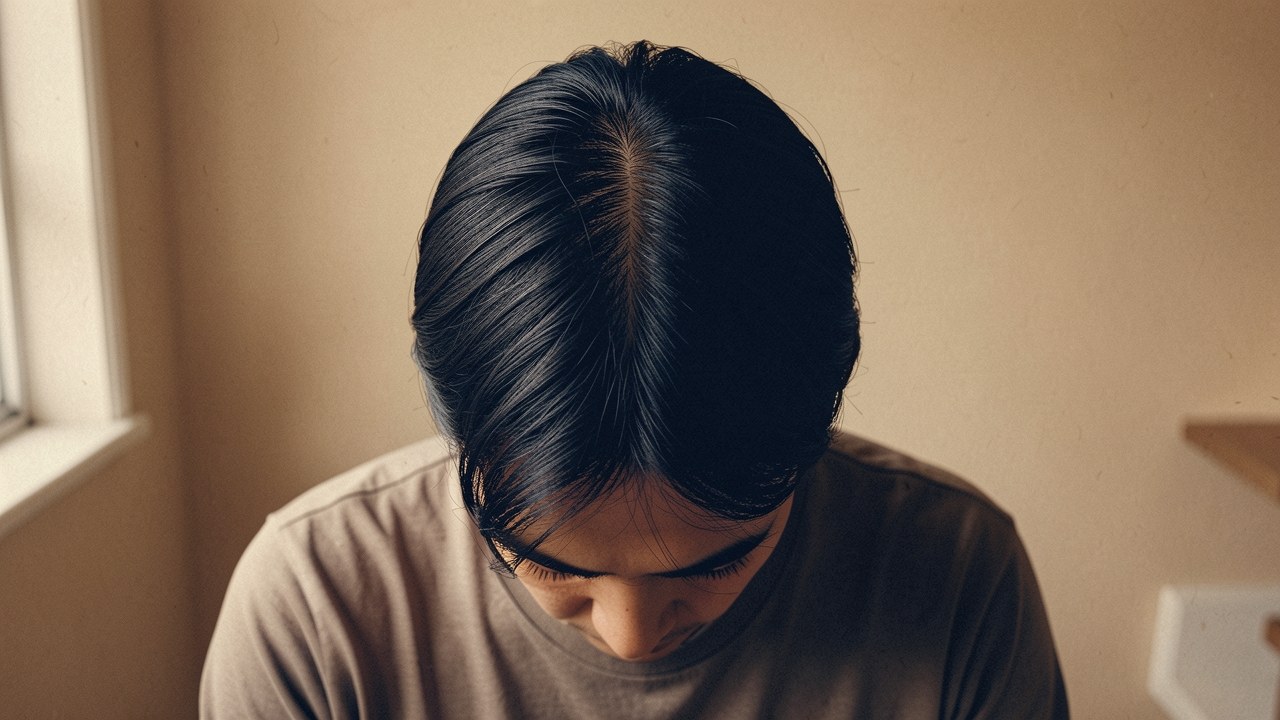
What androgenetic alopecia is
Pattern hair loss is a common form of hair loss that affects both men and women. In men it is also called male pattern baldness, and in women it is called female pattern hair loss. The clinical term for this condition is androgenetic alopecia.
In the United States, androgenetic alopecia is estimated to affect about 50 million men and 30 million women. It can begin as early as a person's teens, and the risk increases with age. More than half of men over age 50 have some degree of hair loss, and in women this form of hair loss is most likely after menopause.
The condition primarily affects the top and front of the scalp. It does not usually affect the sides or back of the head in the same way, which is why the pattern is often described as a distinct shape rather than uniform thinning.
- Common in both sexes, but with different visible patterns
- Often begins gradually and becomes more noticeable with age
- Primarily affects the top and front of the scalp
- More than 50 percent of men over age 50 have some degree of hair loss
Sources: MedlinePlus (U.S. National Library of Medicine, NIH), Wikipedia
Typical male pattern: temple recession and crown thinning
In men, androgenetic alopecia usually begins above both temples. Over time the hairline recedes to form a characteristic M shape. Hair also thins at the top of the head, often called the vertex or crown, and can progress to partial or complete baldness.
The pattern is not identical in everyone. Some men notice a receding front hairline first, others notice thinning at the crown, and many experience a combination of both. The sides and back of the scalp often remain, which is why the remaining hair can form a horseshoe shape in advanced cases.
This pattern reflects how hair follicles respond to androgens over time. Not every man with a receding hairline has male pattern baldness, but the combination of bitemporal recession and crown thinning is the classic presentation.
- Starts above both temples
- Hairline recedes over time, forming an M shape
- Thinning at the top of the head (vertex or crown)
- Can progress to partial or complete baldness
- Sides and back often retain hair
Sources: MedlinePlus (U.S. National Library of Medicine, NIH), Wikipedia
Typical female pattern: part-line widening and diffuse thinning
In women, the pattern differs from the typical male pattern. Hair becomes thinner at the top of the head, and the middle part widens. The hairline does not typically recede in the way it often does in men. Instead, thinning is more diffuse across the top of the scalp.
Female pattern hair loss rarely leads to total baldness. Many women notice a widening part or a decrease in overall volume rather than a distinct bald patch. The frontal hairline is usually preserved, which can make the condition less obvious to others but still distressing.
Because the pattern is diffuse, it can be confused with other causes of hair shedding. A clinician can help distinguish between pattern hair loss and conditions that cause temporary or patchy shedding.
- Thinning at the top of the head
- Middle part widens
- Hairline usually does not recede
- Rarely leads to total baldness
- Diffuse thinning rather than distinct bald patches
Sources: MedlinePlus (U.S. National Library of Medicine, NIH), Wikipedia
Genetic and hormonal factors in general terms
Pattern hair loss is caused by a combination of genetic and hormonal factors. In men, the condition is related to hormones called androgens, specifically dihydrotestosterone (DHT). Androgens also play a role in female pattern hair loss, but other factors that are not yet fully known are involved.
A variety of genetic and environmental factors likely contribute, and most of these risk factors remain unknown. The inheritance pattern is unclear because many factors are involved, but the condition tends to cluster in families. Having a close relative with patterned hair loss appears to be a risk factor.
Scientific studies have confirmed that variations in the AR gene are involved. This gene provides instructions for making the androgen receptor, which allows the body to respond to DHT and other androgens. Some studies suggest that certain AR variations produce androgen receptors that are more easily stimulated than normal, increasing receptor activity in hair follicles, but it remains unclear exactly how these changes increase hair-loss risk. Researchers suspect that variants in several other genes also play a role.
- Caused by a combination of genetic and hormonal factors
- Related to androgens, especially DHT, in men
- AR gene variations are confirmed to be involved
- Multiple other genes are suspected but not confirmed
- Tends to run in families, though the inheritance pattern is unclear
Sources: MedlinePlus (U.S. National Library of Medicine, NIH)
How the hair cycle changes in pattern hair loss
Hair growth begins in follicles. Each strand normally grows for 2 to 6 years, enters a resting phase for several months, and then falls out. After that, the follicle begins growing a new hair.
In pattern hair loss, too much stimulation of hair follicles by androgens may shorten the growth period, producing shorter and thinner strands. The growth of new hair to replace shed strands is also delayed. Together, these changes lead to gradual thinning or loss of hair.
This process is called miniaturization. Over time, affected follicles produce finer, shorter hairs until they may stop producing visible hair altogether. The follicles are not necessarily destroyed, which is why some treatments aim to interrupt the process.
- Normal hair growth lasts 2 to 6 years before shedding
- Androgens may shorten the growth phase
- New hair growth is delayed
- Result is shorter, thinner strands and gradual thinning
Sources: MedlinePlus (U.S. National Library of Medicine, NIH)
How the pattern can progress over time
Pattern hair loss tends to be progressive, but the speed and extent vary widely from person to person. It can start in the teens or twenties and become more noticeable with age. In men, more than half of those over 50 have some degree of hair loss. In women, it is most likely after menopause.
The pattern usually evolves gradually. In men, temple recession may slowly extend backward, and crown thinning may enlarge and connect with the receding hairline. In women, part-line widening and diffuse thinning may become more apparent over years. Some people progress slowly, while others notice faster changes.
The rate can vary over time, and the condition does not always follow a straight line. This is one reason why a clinician's assessment is useful if you are concerned about changes.
- Usually progressive, but speed varies
- Can start in teens or twenties
- More than 50 percent of men over 50 have some degree of hair loss
- In women, most likely after menopause
- Pattern may evolve gradually over years
Sources: MedlinePlus (U.S. National Library of Medicine, NIH)
When pattern loss can be confused with other types
Pattern hair loss primarily affects the top and front of the scalp, but other conditions can cause hair loss in similar areas. Telogen effluvium, for example, causes diffuse shedding that may look like female pattern hair loss. Alopecia areata causes patchy loss that can sometimes be mistaken for other patterns.
A receding hairline does not always mean male pattern baldness. Other causes of hair loss can affect the frontal hairline, and a clinician can distinguish between them by examining the scalp and asking about the history of the loss.
Because the visible pattern is only one piece of the picture, it is important not to self-diagnose. If you are unsure whether your thinning fits pattern hair loss, a professional evaluation can provide clarity.
- Telogen effluvium causes diffuse shedding that can resemble female pattern
- Alopecia areata causes patchy loss
- A receding hairline does not always indicate male pattern baldness
- Clinical examination helps distinguish between conditions
Sources: MedlinePlus (U.S. National Library of Medicine, NIH), Wikipedia
How to describe your pattern to a clinician
When you see a clinician about hair loss, a clear description of what you have noticed can help. You do not need to use medical terms. Simple observations about where the loss started, how it has changed, and whether the hairline or part line has changed are useful.
It also helps to mention how long you have noticed the change and whether anyone in your family has similar hair loss. If you have photos from different times, they can help show how the pattern has evolved.
You can also note whether the loss is mainly at the temples, the crown, or the part line. This information helps the clinician match what they see with your description.
- Where did you first notice the change?
- How has the pattern changed over time?
- Has your hairline or part line changed?
- Does anyone in your family have similar hair loss?
- Have you taken photos that show changes over time?
Sources: MedlinePlus (U.S. National Library of Medicine, NIH), Wikipedia
When to seek professional evaluation
Hair loss can have many causes, and some are not related to pattern hair loss. A clinician can help determine whether your hair loss fits androgenetic alopecia or something else. This is especially important if the loss is sudden, patchy, or accompanied by other symptoms.
If you notice a receding hairline or widening part, it is reasonable to seek evaluation at any point. You do not need to wait for the pattern to become advanced. Early assessment can help you understand what is happening and what options may be appropriate.
Pattern hair loss is associated with other conditions in some people. In men, it has been associated with coronary heart disease, enlargement of the prostate, prostate cancer, insulin resistance such as diabetes and obesity, and high blood pressure. In women, it is associated with an increased risk of polycystic ovary syndrome (PCOS). These are associations, not proof that one causes the other, but they are worth discussing with a clinician.
- Sudden or patchy loss
- Loss accompanied by pain, itching, or scaling
- Concern about the pattern or rate of change
- Other medical conditions that may be related
Sources: MedlinePlus (U.S. National Library of Medicine, NIH), Wikipedia
What pattern hair loss is not
Pattern hair loss is not caused by poor hair care or by washing your hair too often. If you are concerned about how hair-care habits affect your hair, a clinician or dermatologist can provide guidance.
Stress is not described as a cause of androgenetic alopecia. The primary drivers are genetic and hormonal factors.
Pattern hair loss is also not the same as hair shedding from illness, nutritional deficiencies, or medications. Those can cause temporary or diffuse loss that may look similar but has different causes and different management.
- Not caused by poor hair care
- Not caused by stress alone
- Distinct from temporary shedding due to illness or deficiency
- Genetic and hormonal factors are the main drivers
Sources: MedlinePlus (U.S. National Library of Medicine, NIH)
Frequently asked questions
Is female pattern hair loss the same as male pattern baldness?
They are the same condition, androgenetic alopecia, but the visible patterns differ. In men, hair loss typically begins above the temples and may progress to an M-shaped hairline and crown thinning. In women, hair thins at the top of the head and the middle part widens, while the hairline usually does not recede. Female pattern hair loss rarely leads to total baldness.
Sources: MedlinePlus (U.S. National Library of Medicine, NIH)Can pattern hair loss start in your twenties?
Yes. Androgenetic alopecia can start as early as a person's teens, and the risk increases with age.
Sources: MedlinePlus (U.S. National Library of Medicine, NIH)Does it always progress?
Pattern hair loss tends to be progressive, but the speed and extent vary. Some people experience slow changes over decades, while others notice faster progression. The rate can vary over time.
Sources: MedlinePlus (U.S. National Library of Medicine, NIH)Is pattern hair loss caused by stress?
Stress is not a known cause of androgenetic alopecia. The condition is caused by a combination of genetic and hormonal factors.
Sources: MedlinePlus (U.S. National Library of Medicine, NIH)Do hair-care products affect pattern hair loss?
Hair-care products are not known to cause or worsen androgenetic alopecia. Pattern hair loss is driven by genetic and hormonal factors, not by shampoo, styling products, or washing frequency. If you have concerns about your hair-care routine and hair loss, a clinician can provide personalized advice.
Sources: MedlinePlus (U.S. National Library of Medicine, NIH)Does a receding hairline always mean male pattern baldness?
No. A receding hairline is common in male pattern baldness, but it does not always indicate that condition. A clinician can distinguish between them by examining the scalp and taking a history.
Sources: MedlinePlus (U.S. National Library of Medicine, NIH), WikipediaSources
- Androgenetic alopecia: MedlinePlus Genetics — MedlinePlus (U.S. National Library of Medicine, NIH)
- Pattern hair loss - Wikipedia — Wikipedia