What alopecia areata is
Alopecia areata is an autoimmune disorder in which the immune system targets growing hair follicles. The follicles are not destroyed, which is why the hair loss is described as non-scarring and why regrowth remains possible. The condition is the second most frequent form of non-scarring hair loss after male and female pattern hair loss. It is not contagious, and it is not caused by poor hygiene or a hair care routine.
The mechanism involves a T-lymphocyte-mediated attack on anagen-phase hair follicles. In simpler terms, immune cells gather around the lower part of the growing hair follicle and disrupt the follicle's normal immune privilege, leading to loss of the hair shaft. Skin biopsies of affected areas typically show a lymphocytic infiltrate in and around the bulb or lower part of the anagen follicle. Alopecia areata is also a polygenic condition, meaning multiple genes contribute to susceptibility, and inheriting a genetic predisposition does not guarantee that the condition will develop.
- Non-scarring: the follicle is preserved, so regrowth is possible.
- Autoimmune: the immune system mistakenly attacks growing hair follicles.
- Polygenic: several genes influence susceptibility, not a single gene.
- Not contagious: it cannot be passed from person to person through contact.
Sources: Nat Rev Dis Primers / PMC (NIH), MedComm / PMC (NIH), Cold Spring Harb Perspect Med / PMC (NIH)
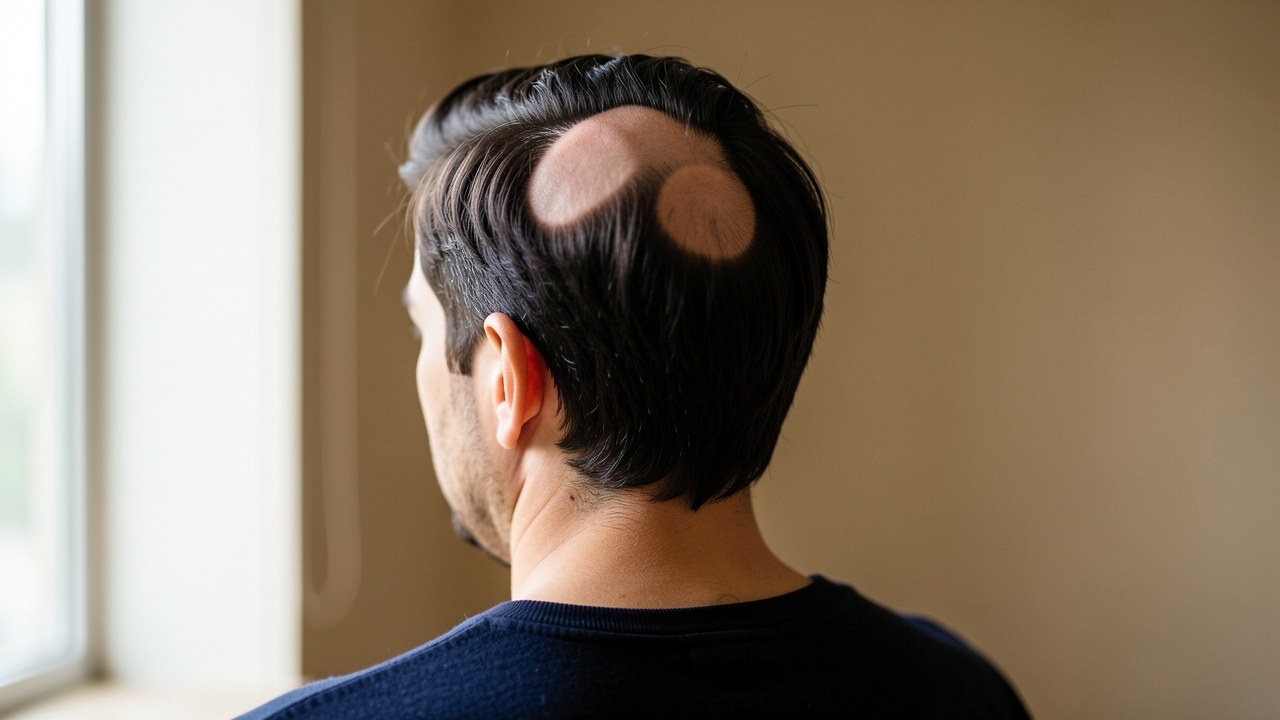
Typical patchy presentation on the scalp
The most common pattern is one or more well-defined round or oval patches of hair loss on the scalp. These patches are often roughly coin-sized, and the skin inside them usually looks normal or only slightly reddened, without scaling, crusting or scarring. During an active phase, short broken hairs called exclamation point hairs may be visible at the margins of a growing patch. These hairs are thinner near the scalp and occur only in acute forms of the condition; they are not usually seen in areas of long-standing hair loss.
Alopecia areata can affect any hair-bearing area of the body, not only the scalp. The beard, eyebrows, eyelashes and pubic area may be involved, and in some cases the eyebrows or eyelashes can be the only sites affected. As the condition progresses, patches may increase in number and merge into irregular shapes. Less common patterns include ophiasis, in which hair loss forms a band-like distribution along the posterior and lateral scalp margins, and alopecia totalis, which is complete loss of scalp hair. Alopecia universalis refers to loss of all body hair. A diffuse subtype known as alopecia areata incognita presents as sudden widespread shedding and diffuse thinning without classic patches, and it can resemble telogen effluvium or diffuse androgenetic alopecia.
- Patchy: round or oval bare areas, often coin-sized, with normal-appearing skin.
- Ophiasis: a band-like pattern along the back and sides of the scalp.
- Totalis and universalis: complete scalp hair loss or loss of all body hair.
- Incognita: sudden diffuse shedding without well-defined patches.
- Non-scalp sites: beard, eyebrows, eyelashes and other hair-bearing areas can be involved.
Sources: Can Fam Physician / PMC (NIH), MedComm / PMC (NIH), Dermatol Ther (Heidelb) / PMC (NIH), Cold Spring Harb Perspect Med / PMC (NIH)
Who it affects, including children and adults
Alopecia areata affects approximately 2 percent of people worldwide at some point in their lifetime. It can begin at any age, but most people who develop it do so before age 40, with the peak incidence in the 20s and 30s. Formal population studies have not found a consistent sex predominance, and the condition affects individuals across racial and ethnic backgrounds. In the United States, one older nationally representative survey reported alopecia areata in roughly 0.1 to 0.2 percent of the population at any given time, though the recency of that survey data is not established here.
Children can develop alopecia areata. Among children, 80 to 85 percent have mild to moderate hair loss involving less than half the scalp at first presentation, compared with about 58 percent of adults who present with patchy loss involving less than half the scalp. Onset in the first two decades of life is associated with a greater lifetime likelihood of extensive hair loss, and a younger age of onset tends to correlate with more severe disease. Family history is present in a minority of patients and is seen more often in those who present as children. Approximately 20 percent of patients have at least one first-degree relative with the condition.
Alopecia totalis and alopecia universalis together account for approximately 7.3 percent of alopecia areata cases, and in the reviewed data these forms occurred before age 30. These figures come from a single systematic review of prior studies and should be understood as broad estimates rather than fixed rules. The occipital region of the scalp has been reported as the most commonly involved site, affected in about 38.4 percent of males and 33.4 percent of females in the same review, but this specific figure is not corroborated by other sources.
- Lifetime risk: about 2 percent of people worldwide.
- Age of onset: can occur at any age; most cases begin before 40, peaking in the 20s and 30s.
- Children: most present with less than half the scalp involved.
- Family history: a minority of patients have an affected first-degree relative.
- Sex: formal population studies do not show a consistent predominance.
Sources: Nat Rev Dis Primers / PMC (NIH), Clin Cosmet Investig Dermatol / PMC (NIH), Can Fam Physician / PMC (NIH), MedComm / PMC (NIH), Cold Spring Harb Perspect Med / PMC (NIH)
How it can remit and recur over time
Alopecia areata often follows a variable, typically relapsing and remitting course. The pattern of hair loss and regrowth is unpredictable for any individual. The initial patch may expand, hair may regrow within a few months, or new patches may appear at various intervals. Some people experience a single episode that resolves, while others have repeated cycles of loss and regrowth over years.
Spontaneous regrowth occurs in a significant proportion of people. One systematic review reports that spontaneous regrowth occurs in approximately 80 percent of patients within the first year, and sudden relapse can occur at any time. A clinical review describes spontaneous resolution and regrowth of a patch in up to 50 to 80 percent of individuals in certain subgroups. These numbers come from reviews that summarize heterogeneous studies, so they are approximate rather than guarantees. There is currently no preventative therapy or cure for alopecia areata, and no therapy has been shown to prevent relapse.
- Relapsing-remitting: periods of hair loss can alternate with periods of regrowth.
- Unpredictable: no reliable way to forecast an individual's pattern.
- Regrowth: often occurs within the first year in many cases, but rates vary.
- No cure or prevention: current treatments aim to manage the condition, not eliminate it.
Sources: Nat Rev Dis Primers / PMC (NIH), Clin Cosmet Investig Dermatol / PMC (NIH), Can Fam Physician / PMC (NIH), MedComm / PMC (NIH)
How it differs from pattern hair loss and telogen effluvium
Alopecia areata is distinct from androgenetic alopecia, commonly called male or female pattern hair loss. Androgenetic alopecia is androgen-dependent and polygenic. In men it typically produces a receding hairline and crown loss, while in women it often causes diffuse thinning with a preserved frontal hairline. Alopecia areata, by contrast, produces discrete, well-defined patches of non-scarring loss and is driven by an autoimmune attack on the follicle rather than by androgen hormones.
Alopecia areata also differs from telogen effluvium, which is excessive shedding of hairs that have entered the resting phase. Telogen effluvium may be acute and self-limiting after events such as childbirth, a febrile illness, major surgery or rapid weight loss, or it may be chronic and sometimes associated with female pattern hair loss. Telogen effluvium tends to cause diffuse shedding rather than smooth patches of complete hair loss. The diffuse subtype of alopecia areata, alopecia areata incognita, can resemble telogen effluvium, which is why professional evaluation and sometimes dermoscopy are helpful. Dermoscopy in alopecia areata incognita commonly shows numerous round or polycyclic yellow dots, regrowing hairs and pigtail hairs.
- Pattern hair loss: androgen-dependent, gradual, follows a typical scalp distribution.
- Telogen effluvium: diffuse shedding after a trigger, often self-limiting.
- Alopecia areata: discrete patches, autoimmune, follicle preserved.
- Overlap: the diffuse subtype can mimic telogen effluvium, so evaluation matters.
Sources: Nat Rev Dis Primers / PMC (NIH), Dermatol Ther (Heidelb) / PMC (NIH), Cold Spring Harb Perspect Med / PMC (NIH)
Associated conditions described in general terms
Alopecia areata is associated with several other conditions. Psychiatric comorbidities, including depression and anxiety, are reported in people with the condition. Autoimmune and atopic conditions such as thyroid disease, vitiligo, atopy and type 1 diabetes occur in some patients. These associations do not mean that every person with alopecia areata will develop another condition, and they do not establish a cause-and-effect relationship. They are patterns observed in clinical and population studies.
Nail involvement is also seen in alopecia areata. It may present as pitting, small depressions in the nail surface, and is reported in up to 7 to 66 percent of patients depending on the series. This wide range reflects differences in how studies were conducted and in the populations studied. Nail involvement is more commonly seen in severe alopecia areata and is considered a poor prognostic factor. Not everyone with alopecia areata has nail changes, and the presence of nail changes alone does not confirm the diagnosis.
- Psychiatric: depression and anxiety are more common in people with alopecia areata.
- Autoimmune and atopic: thyroid disease, vitiligo, atopy and type 1 diabetes in some patients.
- Nails: pitting or other changes can occur, especially in severe cases.
- Not causal: associations describe patterns, not direct cause and effect.
Sources: Clin Cosmet Investig Dermatol / PMC (NIH), Can Fam Physician / PMC (NIH), MedComm / PMC (NIH), Cold Spring Harb Perspect Med / PMC (NIH), Int J Trichology / PMC (NIH)
When to seek professional evaluation
Sudden or patchy hair loss is a reason to seek evaluation from a qualified health professional. A clinician can distinguish alopecia areata from other forms of hair loss, such as pattern hair loss, telogen effluvium or scarring alopecia, which require different approaches. Diagnosis is usually made based on clinical examination, and dermoscopy or a skin biopsy may be used when the presentation is unclear.
Evaluation is especially important when hair loss is widespread, involves the eyebrows or eyelashes, or is accompanied by scalp symptoms such as itching, burning or tenderness. Nail changes, a personal or family history of autoimmune conditions, and rapid progression are also useful information to share. Because alopecia areata can remit and recur, a professional can help track changes over time and discuss whether any treatment is appropriate. Treatment options described in the medical literature include topical, intralesional or systemic corticosteroids, topical immunotherapy, topical minoxidil and systemic immunosuppressants, with success rates varying by extent and duration of disease. No therapy has been shown to prevent relapse, so the goal is usually management rather than cure.
- See a clinician for a new patch of hair loss or sudden diffuse shedding.
- Seek evaluation if the eyebrows, eyelashes or large areas of the scalp are involved.
- Report scalp symptoms, nail changes and any personal or family history of autoimmune disease.
- Ask about diagnosis, monitoring and whether treatment is appropriate for your situation.
Sources: Nat Rev Dis Primers / PMC (NIH), Clin Cosmet Investig Dermatol / PMC (NIH), Can Fam Physician / PMC (NIH), Dermatol Ther (Heidelb) / PMC (NIH)
Frequently asked questions
Is alopecia areata caused by stress?
Alopecia areata is an autoimmune condition, and the supplied medical literature does not establish stress as its cause. The condition arises from a T-lymphocyte-mediated attack on anagen hair follicles in people with a genetic predisposition. Stress may be a trigger or aggravating factor in some individuals, but the evidence presented here does not support the claim that stress causes alopecia areata. If you are concerned about stress and hair loss, a clinician can help evaluate the full picture.
Sources: Nat Rev Dis Primers / PMC (NIH), Cold Spring Harb Perspect Med / PMC (NIH)Does hair regrow in alopecia areata?
Yes, regrowth is possible because the hair follicle is not destroyed. The condition is non-scarring, meaning the follicle is preserved. Spontaneous regrowth occurs in a significant proportion of people. One systematic review reports that about 80 percent of patients experience spontaneous regrowth within the first year, and a clinical review describes spontaneous resolution and regrowth in up to 50 to 80 percent of individuals in certain subgroups. These figures are approximations from reviews of heterogeneous studies, so they cannot predict what will happen for any one person. Relapse can also occur at any time.
Sources: Clin Cosmet Investig Dermatol / PMC (NIH), Can Fam Physician / PMC (NIH)Can alopecia areata affect children?
Yes, alopecia areata can affect children. Among children, 80 to 85 percent have mild to moderate hair loss involving less than half the scalp at first presentation, compared with about 58 percent of adults. Onset in the first two decades of life is associated with a greater lifetime likelihood of extensive hair loss. Family history is present in a minority of patients and is seen more often in those who present as children. If a child develops patchy hair loss, a pediatrician or dermatologist can evaluate the cause.
Sources: Clin Cosmet Investig Dermatol / PMC (NIH)Does alopecia areata affect the nails too?
Nail changes can occur in alopecia areata. The most commonly described change is pitting, which means small depressions in the nail surface. Reported frequency varies widely, from about 7 to 66 percent of patients depending on the study, so no single figure applies to everyone. Nail involvement is more commonly seen in severe alopecia areata and is considered a poor prognostic factor. Not everyone with alopecia areata has nail changes, and nail pitting alone does not confirm the diagnosis.
Sources: Clin Cosmet Investig Dermatol / PMC (NIH), Can Fam Physician / PMC (NIH)Sources
- Alopecia areata — Nat Rev Dis Primers / PMC (NIH)
- Epidemiology and burden of alopecia areata: a systematic review — Clin Cosmet Investig Dermatol / PMC (NIH)
- Alopecia areata: Part 1: pathogenesis, diagnosis, and prognosis — Can Fam Physician / PMC (NIH)
- Alopecia Areata: Pathogenesis, Diagnosis, and Therapies — MedComm / PMC (NIH)
- Alopecia Areata Incognita: Current Evidence — Dermatol Ther (Heidelb) / PMC (NIH)
- An Overview of Alopecias — Cold Spring Harb Perspect Med / PMC (NIH)
- Annular alopecia areata: a morphologically rare variant - PMC — Int J Trichology / PMC (NIH)