What telogen effluvium is within the hair growth cycle
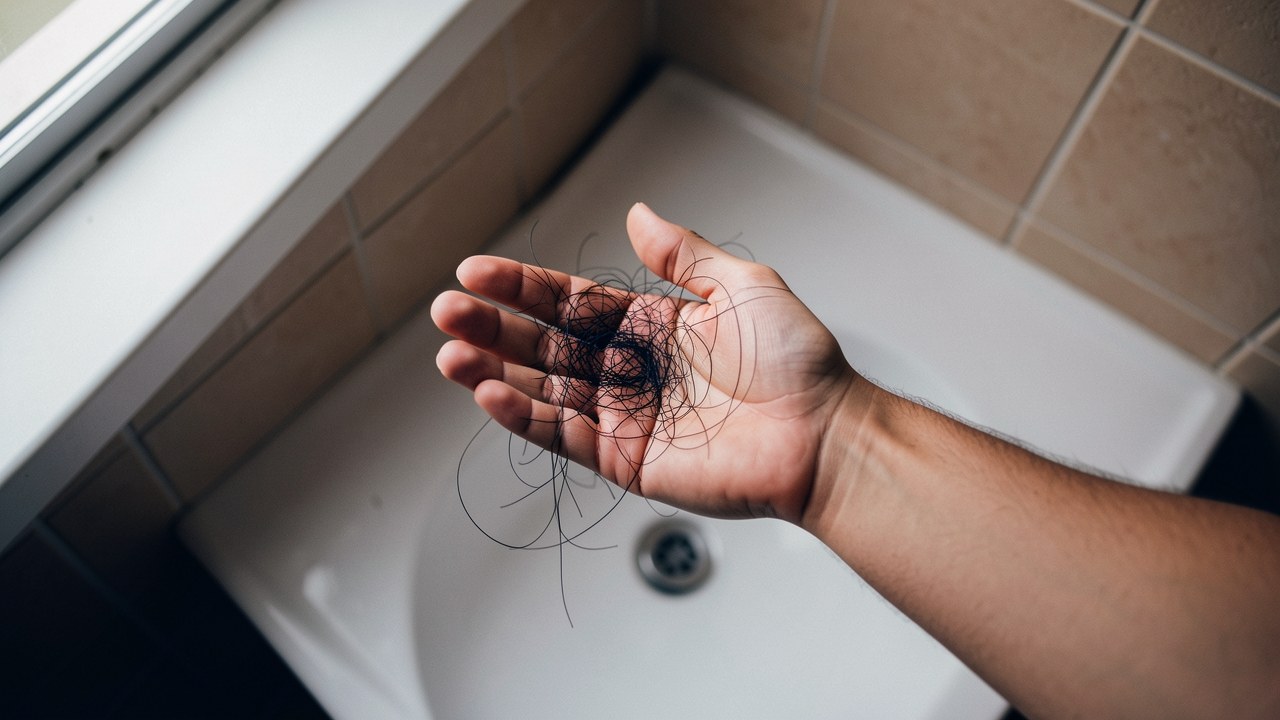
Hair grows in cycles. At any given time, most follicles are actively producing a hair shaft, while a smaller share are resting. In a normal scalp, roughly 10 to 15 percent of follicles sit in the resting, or telogen, phase. Those resting hairs are eventually released, which is why some daily shedding is normal.
Telogen effluvium is a temporary shift in that balance. A larger-than-usual share of follicles moves into the resting phase at roughly the same time, so more hairs are released together several weeks or months later. In telogen effluvium, the proportion of follicles in telogen can rise to about 30 percent or more. The shedding is diffuse, meaning it comes from across the scalp rather than from one patch.
The key point is that telogen effluvium changes the timing of the hair cycle, not the structure of the follicle. Hair follicles are not destroyed, and there is no miniaturization of the kind seen in pattern hair loss. That is why regrowth is generally expected once the underlying trigger has been addressed.
- Normal resting-phase share: roughly 10 to 15 percent of scalp follicles.
- In telogen effluvium: the resting share can rise to around 30 percent or more.
- Ordinary daily shedding: about 50 to 100 hairs per day.
- Active telogen effluvium shedding: often reported in the range of roughly 200 to 500 hairs per day, though this varies from person to person.
Sources: Istanbul Care, Hair GP, Yaker MD (Plano, TX), NewHair PS
Common triggers: what tends to set off diffuse shedding
Telogen effluvium usually has a trigger, even if it is not obvious at first. The most consistently documented triggers are major physical stress such as surgery, severe illness or high fever; emotional stress; childbirth; rapid weight loss or crash dieting; and some medications. Nutritional factors, especially low iron, low protein and certain vitamin deficiencies, are also reported as contributing factors.
Because the shedding appears months after the trigger, people often overlook the connection. A bout of flu in early spring might show up as heavy shedding in early summer. A difficult life event or a significant change in eating patterns can do the same. The trigger does not need to feel dramatic in the moment; what matters is whether it represented a real physical or emotional strain on the body.
Postpartum shedding is a well-recognized form of telogen effluvium and typically begins within a few weeks to about three months after childbirth. Medication-related shedding depends on the drug and the person, so specific medication questions belong with a prescribing clinician rather than a general guide.
- Major physical stress: surgery, severe illness, high fever.
- Emotional stress or a significant life disruption.
- Childbirth or postpartum hormonal changes, often with shedding starting within weeks to a few months afterward.
- Rapid weight loss, crash dieting or a major change in eating patterns.
- Some medications, which should be reviewed with the prescriber.
- Nutritional shortfalls, particularly iron, protein and certain vitamins.
Sources: Istanbul Care, Hair GP, Yaker MD (Plano, TX), TelogenEffluvium.com
The timeline from trigger to shedding and recovery
The lag between a trigger and visible shedding is one of the most useful clues. Telogen effluvium shedding typically becomes noticeable about two to three months after the triggering event. That delay happens because affected hairs must complete the resting portion of the cycle before they are released.
Once the trigger is resolved, shedding often continues for around three to six months before it tapers off. Hair density does not bounce back on the same schedule. Visible recovery of fullness typically takes six to twelve months, and it can lag behind the point when shedding stops. Some people notice substantial improvement earlier, in the range of six to nine months, but the slower timeline is common enough that it is worth planning around.
Acute telogen effluvium is generally defined as lasting less than six months, with a sudden onset after a clear trigger and typically complete recovery. When diffuse shedding persists longer than six months, it is described as chronic telogen effluvium. Ongoing stress, nutritional deficiencies such as low ferritin, and co-occurring conditions are reported to prolong the recovery timeline.
| Stage | Typical window | What is usually happening |
|---|---|---|
| Trigger | Day 0 | A physical or emotional stress, hormonal change, weight change or other documented trigger occurs. |
| Latency | About 2 to 3 months | Affected follicles finish the resting phase before hairs are released, so shedding is not immediate. |
| Active shedding | Roughly 3 to 6 months after the trigger resolves | Daily shedding is higher than usual and is diffuse across the scalp. |
| Visible recovery | About 6 to 12 months | Density gradually returns; regrowth can lag behind the end of shedding. |
Sources: Istanbul Care, Hair GP, Yaker MD (Plano, TX), TelogenEffluvium.com, NewHair PS
How diffuse shedding differs from pattern hair loss
Telogen effluvium and androgenetic alopecia, also called pattern hair loss, can look similar in a bathroom mirror but behave very differently. Telogen effluvium has a sudden onset and affects the whole scalp in a diffuse way. Pattern hair loss develops gradually over years and follows a recognizable distribution: the temples and crown in men, and a widening central part in women.
The underlying process is different as well. Pattern hair loss involves follicular miniaturization, where hairs become progressively finer over time, and it is driven by genetic predisposition and hormonal sensitivity. Telogen effluvium does not miniaturize follicles, and the follicles are not destroyed. Pattern hair loss often needs long-term management, while telogen effluvium has a good chance of reversing once the trigger is addressed.
The two can also coexist. A telogen effluvium episode can unmask underlying pattern hair loss that was already present, which is one reason a clinician may look at both possibilities rather than assuming only one is at play. Trichoscopy, a specialist examination of the scalp with a magnifying instrument, can help distinguish them: it looks for signs of miniaturization, which characterize pattern hair loss rather than telogen effluvium.
| Feature | Telogen effluvium | Androgenetic alopecia (pattern hair loss) |
|---|---|---|
| Onset | Sudden, excessive shedding, often noticeable 2 to 3 months after a trigger | Gradual, progressive over years |
| Distribution | Diffuse across the entire scalp, not localized | Patterned: temples and/or crown; widening central part in women |
| Causes | Often linked to a specific trigger such as illness, stress, childbirth, weight loss, medications or nutritional deficiency | Genetic predisposition and hormonal sensitivity, progressive |
| Follicle status | Follicles are not destroyed; no miniaturization | Follicles miniaturize over time |
| Prognosis | Often reversible; good chance of regrowth once the trigger is addressed | Long-term management often needed |
Sources: Istanbul Care, Hair GP, Yaker MD (Plano, TX), NewHair PS
What telogen effluvium does not include
Telogen effluvium produces diffuse shedding across the whole scalp rather than localized bald patches. If you are seeing a clearly defined smooth patch, a receding hairline or a widening part that has changed slowly over years, that pattern points toward a different explanation, and pattern hair loss is one of the common ones.
It also does not destroy hair follicles. The shedding is a timing problem in the hair cycle, not scarring or permanent loss of the follicle itself. That distinction matters because it is the reason regrowth is generally expected once the trigger resolves.
Finally, telogen effluvium is not the same as hair breakage. Hairs that come out with a small white bulb at the root are shed hairs; short broken fragments without a bulb suggest a different issue. If the appearance of the shed hair is unclear, that is a reasonable thing to mention to a clinician.
- Not localized bald patches, which suggest a different pattern of loss.
- Not follicular destruction or scarring.
- Not a gradual receding hairline or widening part that has developed over years.
- Not the same as hair breakage, which produces short fragments rather than shed hairs with a root bulb.
Sources: Istanbul Care, Hair GP, Yaker MD (Plano, TX), TelogenEffluvium.com, NewHair PS
When shedding warrants professional evaluation
Many telogen effluvium episodes resolve on their own after the trigger passes. Professional evaluation is worth considering when the shedding is persistent, when the pattern does not fit diffuse shedding, or when there is no clear trigger to point to. Diagnosis relies mainly on history and physical examination, and may include blood tests to check for iron deficiency, thyroid problems and other metabolic issues.
A clinician may also use a hair pull test, in which a gentle tug releases strands. An increased number of released strands can support a clinical impression of active shedding, but the result needs context and is not a home diagnosis on its own. In persistent or unclear cases, a scalp biopsy may be used to confirm the diagnosis, though it is not often necessary.
Because telogen effluvium can coexist with pattern hair loss, an evaluation can help separate the two contributors. That is especially useful when shedding slows but density does not seem to return as expected.
- Shedding that continues beyond six months without improvement.
- Loss that is localized, patterned or accompanied by scalp symptoms.
- No identifiable trigger, or several possible triggers at once.
- Shedding that interferes with daily life or causes significant distress.
- A personal or family history of pattern hair loss.
Sources: Istanbul Care, Yaker MD (Plano, TX)
Everyday hair care: what does not cause it and what does not fix it
Telogen effluvium is a shift in the hair cycle, not a reaction to normal grooming. Washing your hair, brushing it, or using ordinary shampoo and conditioner does not cause the condition. Hairs that were already in the resting phase are going to be released on their own schedule; washing simply moves the hairs that were ready to fall anyway. Reducing washing may make the shed hair less visible, but it does not change the underlying process.
The same logic applies to fixing it. No shampoo, scalp treatment or styling routine resolves telogen effluvium on its own. The primary approach is to identify and resolve the underlying trigger. Good general hair care can help you manage the appearance of thinning while you wait, and it can reduce additional breakage, but it is not a treatment for the shedding itself.
One medication does come up in discussion: minoxidil may help some people, but it is not typically the first-line approach for telogen effluvium, and any medication decision belongs with a clinician. Gentle handling, a balanced diet and patience with the timeline are the practical steps most people can take while the cycle rebalances.
- Washing frequency does not cause or worsen telogen effluvium.
- Shampoos, conditioners and scalp treatments do not resolve it on their own.
- Gentle handling reduces breakage but does not change the shedding cycle.
- The main management step is identifying and addressing the trigger.
- Medication questions, including about minoxidil, should go to a clinician.
Sources: Istanbul Care, Yaker MD (Plano, TX), TelogenEffluvium.com
Frequently asked questions
How long does telogen effluvium usually last?
Once the trigger is resolved, shedding often continues for around three to six months before tapering off. Visible recovery of hair density typically takes six to twelve months and can lag behind the point when shedding stops. Acute telogen effluvium is generally defined as lasting less than six months, with sudden onset after a clear trigger and typically complete recovery.
Sources: Istanbul Care, Hair GP, Yaker MD (Plano, TX), TelogenEffluvium.com, NewHair PSCan telogen effluvium become chronic?
Yes. When diffuse shedding persists longer than six months, it is described as chronic telogen effluvium. Ongoing stress, nutritional deficiencies such as low ferritin, and co-occurring conditions are reported to prolong the recovery timeline, which is one reason persistent shedding is worth evaluating with a clinician.
Sources: Istanbul Care, Hair GP, Yaker MD (Plano, TX)Does washing your hair more often make shedding worse?
No. Washing moves hairs that were already in the resting phase and ready to be released; it does not cause telogen effluvium or increase the underlying shedding. Washing less often can make the shed hair less visible because it accumulates between washes, but it does not change the hair cycle. Normal shampoo and conditioner use is not a trigger for this condition.
Sources: Istanbul Care, Hair GP, Yaker MD (Plano, TX)Can diet changes trigger this type of shedding?
Yes. Rapid weight loss, crash dieting and nutritional deficiencies, particularly of iron, protein and certain vitamins, are reported as contributing factors to telogen effluvium. The shedding usually appears about two to three months after the dietary change. Specific nutrient thresholds and whether supplementation is appropriate require individual clinical assessment.
Sources: Istanbul Care, Hair GP, Yaker MD (Plano, TX), TelogenEffluvium.comDoes telogen effluvium cause bald patches?
No. Telogen effluvium produces diffuse shedding across the whole scalp rather than localized bald patches. A clearly defined smooth patch, a receding hairline or a widening part that has changed slowly over years points toward a different explanation, such as pattern hair loss, and is worth having evaluated.
Sources: Istanbul Care, Hair GP, Yaker MD (Plano, TX), TelogenEffluvium.com, NewHair PSSources
- Telogen Effluvium Hair Loss Guide by Istanbul Care — Istanbul Care
- Female Pattern Hair Loss vs Telogen Effluvium Guide - Hair GP — Hair GP
- Telogen Effluvium - Causes, Timeline, Treatment Options, and When to See a Specialist | Joseph Yaker — Yaker MD (Plano, TX)
- Stress Telogen Effluvium: Causes Of Stress Hair Shedding — TelogenEffluvium.com
- Telogen Effluvium Recovery Guide: Causes, Timeline & Care — NewHair PS